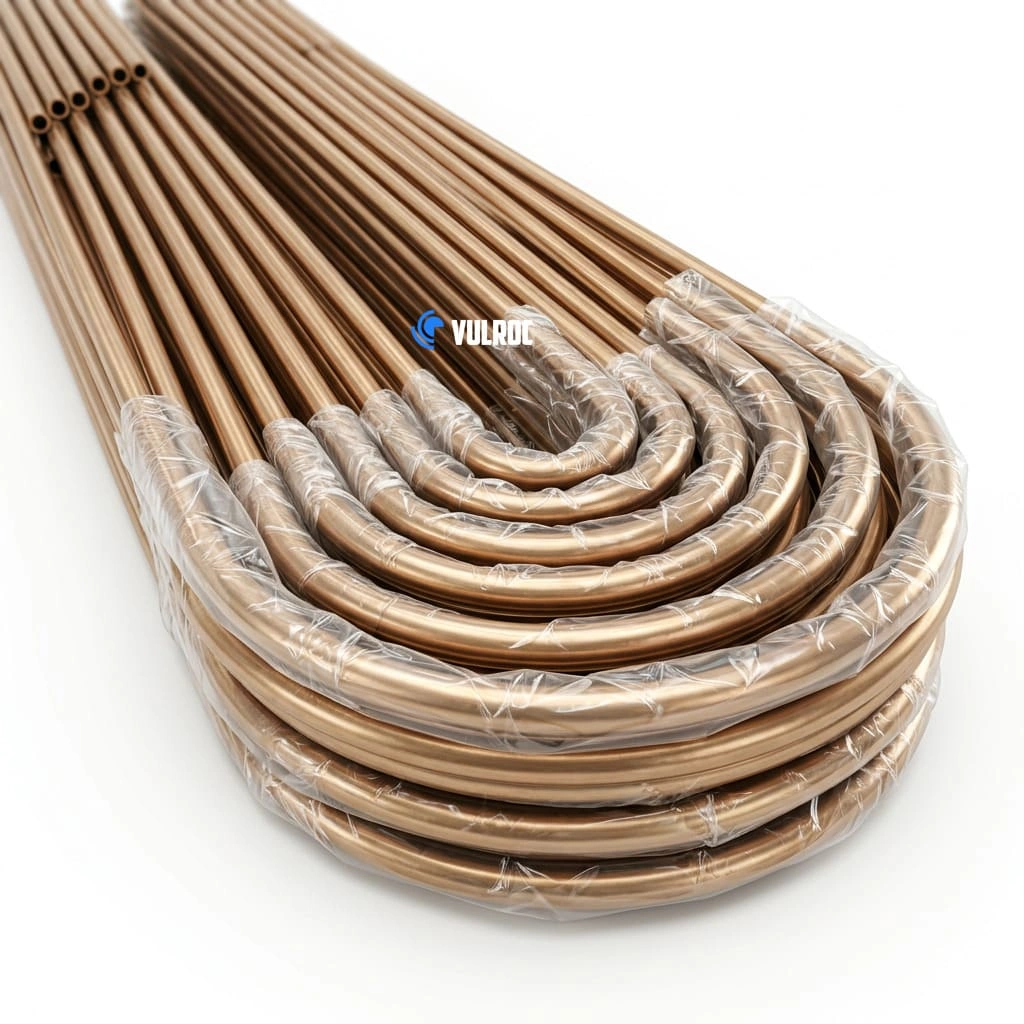
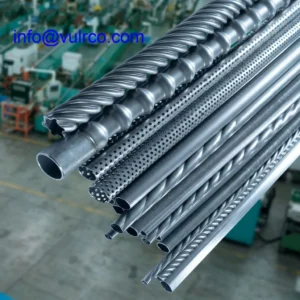
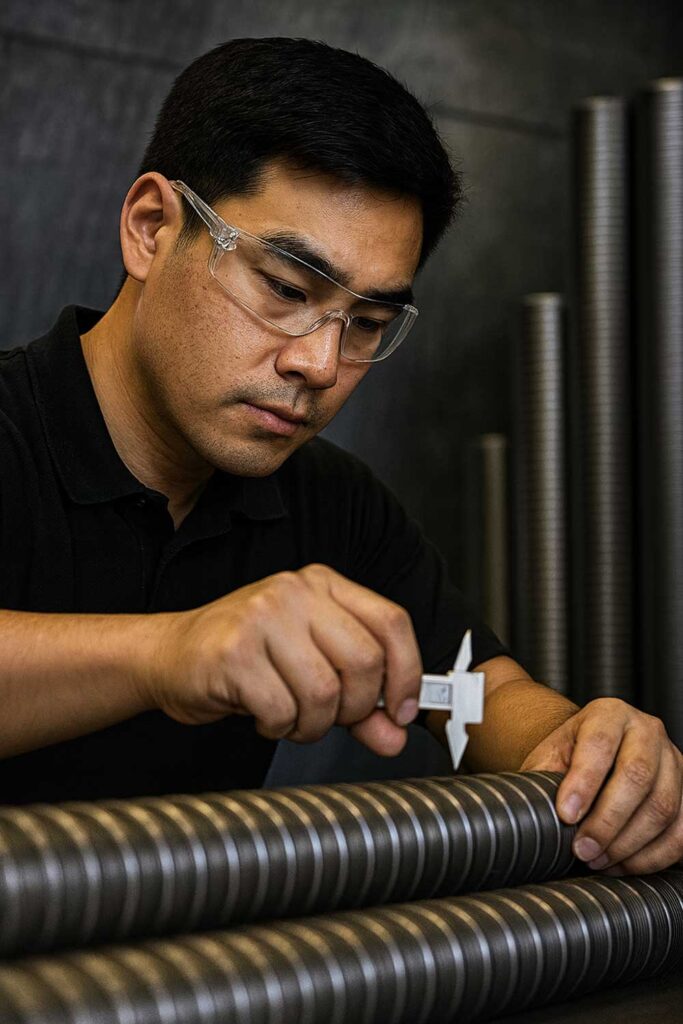
Vulroc® manufactures high-quality alloy steel U-bend tubes designed for compact heat exchanger applications where space efficiency and enhanced heat transfer are essential. The U-bend configuration accommodates thermal expansion and reduces the need for additional fittings, making these tubes ideal for high-pressure and high-temperature service where straight tubes are impractical.
Our in-house precision U-bending facility is capable of producing tight radius bends with controlled ovality and minimal wall thinning. All bends undergo stress-relieving heat treatment in accordance with TEMA (Tubular Exchanger Manufacturers Association) requirements, ensuring long-term structural integrity, reliable performance, and suitability for demanding industrial environments.
Typical Applications:
- Power plant boilers
- Superheaters and reheaters
- Economizers
- High-temperature heat exchangers
- Petrochemical process heaters
- Refinery equipment
- Waste heat recovery systems
- Industrial furnace applications
FAQ
1. What are alloy steel U-bend tubes?
Alloy steel U-bend tubes are seamless tubes bent into a U shape for use in heat exchangers, boilers, and high-temperature equipment. The U-bend design allows thermal expansion, reduces the need for fittings, and improves reliability in high-pressure and high-temperature applications.
2. What are Vulroc® alloy steel U-bend tubes used for?
Vulroc® alloy steel U-bend tubes are commonly used in power plant boilers, superheaters, economizers, petrochemical heat exchangers, and refinery process equipment. They are ideal for high-temperature and high-pressure heat transfer applications.
3. Why use alloy steel for U-bend tubes?
Alloy steel provides improved strength, creep resistance, and oxidation resistance at elevated temperatures compared to carbon steel. This makes alloy steel U-bend tubes suitable for severe service conditions in boilers and thermal equipment.
4. Are U-bend tubes heat treated after bending?
Yes. Vulroc® alloy steel U-bend tubes are stress relieved after bending in accordance with TEMA requirements. This process reduces residual stress and ensures long-term performance in high-temperature service.
5. What alloy steel grades are available?
Common grades include ASTM A213 T5, T9, T11, T12, T22, T91, and ASTM A209 T1. Other grades can be supplied depending on operating temperature and pressure requirements.
6. What is the minimum bending radius?
The bending radius typically starts from 1.5 times the tube outside diameter (1.5D). Larger radii are available depending on tube size, wall thickness, and application requirements.
7. What inspections are performed on alloy steel U-bend tubes?
Inspection includes dimensional checks, bend radius measurement, ovality control, wall thinning inspection, visual inspection, and optional NDT such as Eddy Current, UT, and hydrostatic testing.
8. What standards apply to Vulroc® alloy steel U-bend tubes?
These tubes can be supplied according to ASTM A209, ASTM A213, ASME SA213, EN 10216-2, DIN 17175, JIS G3461, BS 3059, and TEMA requirements.